Level: CM
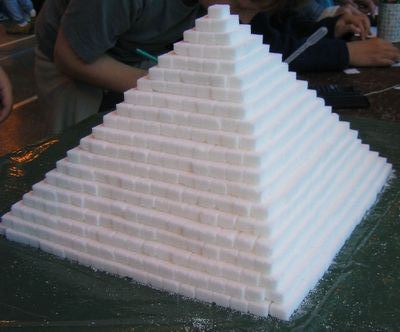
Principle: Make
students calculate how much sugar it takes to build a pyramid (here based on 20 out of 20 sugars, floor next 19 of 19 ...).
Building the pyramid and to do the math to others.
I conducted this activity with 3 students in need of CM2 to conduct a workshop in a mathematical "Science Forum" organized on the town where I work. This activity can also lead to a booth for the festival's year-end school.
For your convenience you need to use sugars square.
It takes 2 hours to climb the pyramid.
This activity has been very successful with students and visitors many students valued organizers.
worked Skills:
- approached the concept of square
- organize and process calculations (multiplicative and additive)
- good use his calculator
- perform a division to determine the number of boxes needed
- suggest and implement possible aids and adaptations for students who attend the workshop based on their grade level
- to become "expert"
procedure possible:
- present the project to students, build cubes with a pyramid structure so that they understand and identify with the basic sugars will be a square of 20 sugar side
- calculating the number of sugars necessary for the base, not hesitate to let them draw a square of 20 squares of graph paper on hand for them to visualize and avoid making 20 + 20 + 20 + 20 (in passing the rule review zeros, which allows the calculation of head 20 x 20)
- calculation of subsequent stages and then adding the 20 results
- how much will he have to buy boxes? First calculate the number of sugars in a box (see ERMEL CM1 p 239) and then perform the division. WARNING, there should be a box more than the result found! For students to become aware of them calculate the number of sugars in the number of boxes to check found that will be enough.
For the stand is open to all, we can offer CE1/CE2 to announce the number of sugars which they think a student who runs the booth ad then "more" or "minus", the one who wins is the exact number ... a sugar! For CM
calculators available can perform the calculation in ten minutes.
Students from Central Science at the forum where we presented this activity, we were astonished by the computing overhead in seconds.
They use the following formula:
n (n + 1) (2n + 1) / 6 where n is the number of sugars on one side of the base of the pyramid.
To decorate your booth, CEDUS (Centre for Study and Documentation of Sucre) provides for nominal 2 beautiful posters there: http://www.lesucre.com (documentation - the catalog - I would like to receive the catalog)


0 comments:
Post a Comment