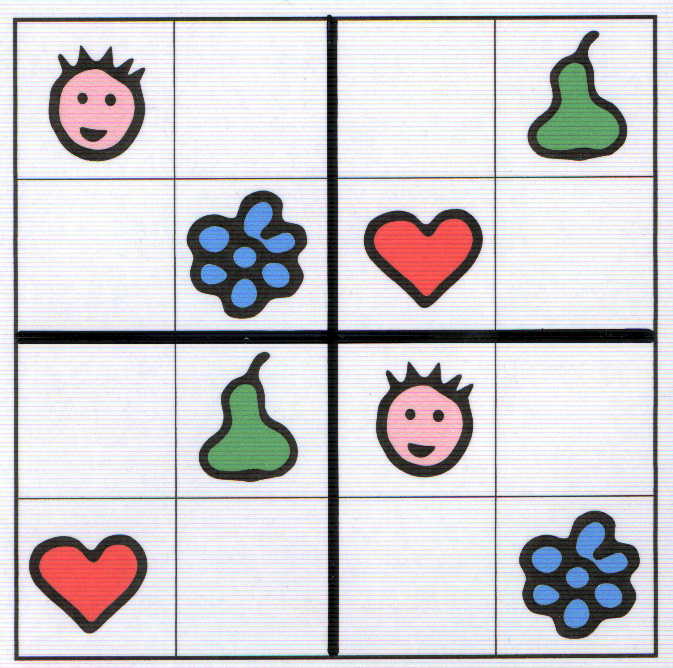
Level: GS
Presentation of the original game: Sudoku (Japanese: Sudoku 数 独 , meaning single number) is a puzzle with numbers. The goal is to fill the grid with numbers from 1 to 9, starting with some numbers already placed in
The explanations above are from Wikipedia: http://fr.wikipedia.org/wiki/Sudoku
Before Sudoku propose to your students, I urge you try if you do not already know this game will allow you to experience all the arguments to be implemented to solve a sudoku.
There are many gates there: http://www.e-sudoku.fr
References:
There are rubrics for kindergarten students where numbers are replaced by drawings on this site: http://www.gap.ien.05.ac-aix-marseille.fr/rre/article.php3?id_article=1262
You can download here 8 grids of difficulty Out: sudoku grids for kindergarten
These grids can be printed and laminated, for what the complete, simply print additional grids and then cut lamination different reasons.
WARNING! The lines delimit the regions are barely thicker than the others, it is essential for optimal viewing of the swell with a marker.
You will also find on this site sudoku grids for elementary students.
worked Skills:
- how to organize objects in space according
3 constraints - work the concepts of line, column (and "Area")
procedure possible:
- an excellent idea of my colleague
deduce what reason - a simple grid resolution (4 different designs) in common with comments: "How you know it a heart that needs to be there ?"...
- Resolution 4 grids simple individual
- continuation of the same approach with the more complex grids (6 different designs), with an additional concern because it is useful to solve these scales to differentiate a certain pattern (it can be placed elsewhere) and a pattern likely to occupy several spaces at first
In the case of two pupils with whom I have tested this activity, I had to accompany the implementation of complex templates:
- help in removing the grounds which made impossible the placement of the following
- their set places to complete (eg 2 empty boxes on the same row, column or region) if they see a reason could occupy two seats in the first instance, the arrival of the second allowed to find a single investment two possible reasons
- give them a reason to invest in a row, column or region
This article was created by Raymond


0 comments:
Post a Comment